
Grease trap cleaning WA isn’t just good housekeeping – it’s a legal requirement.
If you run a café, restaurant, or food business in Western Australia, your grease trap is one of those things that’s easy to ignore – right up until it becomes impossible to ignore.
The smell hits first. Then the blocked drains. Then, potentially, a call from your local council or the WA Health Department.
Here’s what food business operators across Perth, Mandurah, Rockingham and Bunbury need to know.
how often do restaurants need grease trap cleaning wa?
What Does a Grease Trap Actually Do?
A grease trap (also called a grease arrestor) is a plumbing device that captures fats, oils, and grease (FOG) before they enter the sewer or onsite wastewater system. Without it, that FOG solidifies inside pipes, causes blockages, and can create serious environmental and public health problems.
Every commercial kitchen that produces wastewater – restaurants, cafés, bakeries, school canteens, aged care facilities, and more – is typically required to have one installed and maintained.
In WA, that maintenance isn’t optional.
What Are the Legal Requirements for Grease Trap Cleaning in WA?
Under the Food Act 2008 (WA) and the Health (Treatment of Sewage and Disposal of Effluent and Liquid Waste) Regulations 1974, food businesses are required to maintain their grease traps in good working order at all times.
In practice, that means:
- Grease traps must be cleaned before they reach 30% capacity – not when they overflow, not when they smell, but proactively.
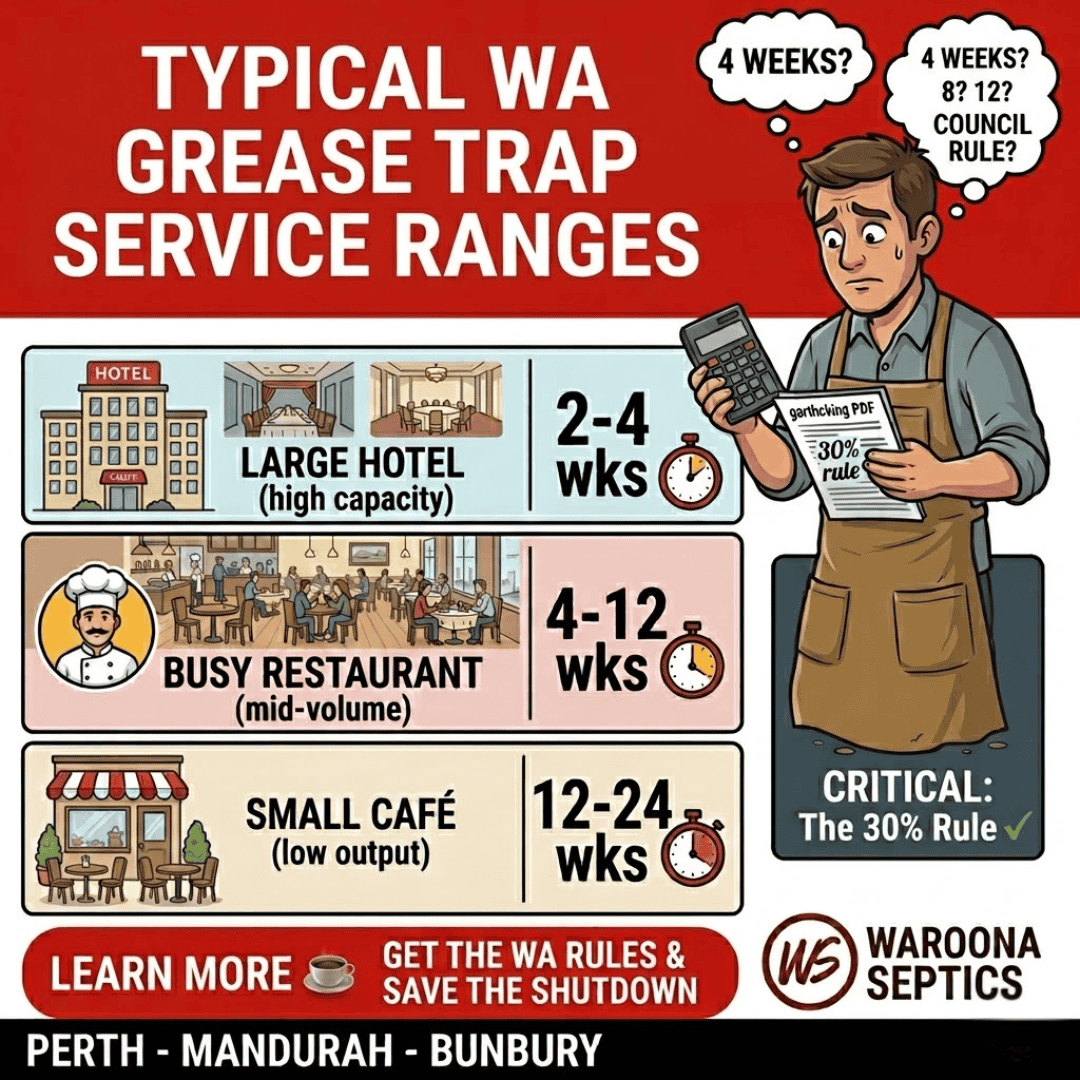
- Cleaning frequency is set by your local council or health authority based on your kitchen’s output and trap size. This is commonly every 4 to 12 weeks for busy, mid-size commercial kitchens.
- Records of pump-outs and cleaning must be kept and may be requested during an inspection.
- Liquid waste removed from grease traps must be disposed of by a licensed liquid waste contractor – you can’t simply flush it or tip it on-site.
Your local council – whether that’s the City of Mandurah, Shire of Harvey, Shire of Murray, or the City of Bunbury – may also have its own specific requirements on top of state regulations. When in doubt, check with them directly, or ask your liquid waste contractor.
How Often Should a Restaurant Grease Trap Be Cleaned?
There’s no single answer that fits every business, but here’s a practical guide:
| Business Type | Typical Cleaning Frequency |
|
Fast food / fish & chips
High-volume kitchen (hotel, club)
Mid-size restaurant
Small café (low output) |
Every 2–4 weeks
Every 2–4 weeks
Every 4–12 weeks
Every 12–24 weeks |
The real rule of thumb: if your trap is more than 30% full of grease and solids, it’s time to clean it. The size of your trap, the volume of your kitchen, and what you’re cooking all affect how fast it fills up.
A good liquid waste contractor will assess your trap after the first couple of cleans and help you set a schedule that keeps you compliant without unnecessary call-outs.
What Happens If You Don’t Clean Your Grease Trap Regularly?
Neglecting your grease trap is one of those decisions that feels fine until it really, truly isn’t. Here’s what you’re risking:
Blocked drains and kitchen shutdowns. When a grease trap overflows, it doesn’t just smell terrible – it can back up into your kitchen sinks and floor wastes. That’s a health hazard and a potential forced closure.
Council fines and enforcement action. Environmental Health Officers can and do inspect commercial premises. If your trap is found to be overloaded, poorly maintained, or if you can’t produce cleaning records, you’re looking at improvement notices, fines, or worse.
Damage to the sewer system. Discharging FOG-heavy wastewater into the public sewer is illegal and costly. Water Corporation can issue infringement notices, and the repair bills – if FOG contributes to a sewer blockage – can be significant.
Reputational damage. Grease trap odours don’t stay in the room. They find their way into dining areas, outdoor seating, and car parks. Customers notice.
Warning Signs Your Grease Trap Needs Attention Now
Don’t wait for your scheduled clean if you notice any of these:
- Slow-draining sinks in the kitchen, particularly after service
- Gurgling or bubbling sounds from floor wastes or drains
- A strong sulphur or rotten-egg smell near the trap or in the kitchen
- Grease visible floating at drain openings or in floor wastes
- Flies or pests congregating around drain areas
- It’s been more than 12 weeks since the last clean and you don’t know its current capacity
If you’re ticking more than one of these boxes, don’t wait until your next scheduled service. Call a licensed liquid waste contractor and get it sorted.
Why Using a Licensed Contractor Matters
Under WA regulations, liquid waste, including the contents of a grease trap, must be collected and disposed of by a licensed liquid waste transporter. This isn’t just a technicality.
Using an unlicensed operator means the waste may not be disposed of legally. If it ends up somewhere it shouldn’t, the liability can come back to your business as well as the contractor.
Always ask for a job docket or receipt after each service. This is your compliance record. A reputable contractor will provide one as a matter of course.
Ready to Get Your Grease Trap Sorted?
Waroona Septics provides professional grease trap cleaning for restaurants, cafés, and food businesses across the Perth to Bunbury corridor – including Mandurah, Rockingham, Pinjarra, Harvey, Waroona, and throughout the Peel region. We’re locally owned, fully licensed, and we work around your operating hours so a clean doesn’t mean a shutdown.
Call us on 0419 244 361 or email admin@waroonaseptics.com.au to book a service or set up a regular maintenance schedule. We’ll keep you compliant, keep your kitchen running, and keep the council off your back.
To read more about our grease trap cleaning services Click Here